

Excel Workbooks: Three-dimensional workbooks and other number-crunching powers - barrettably1938
Stand out workbooks are the next step afterward you've perfect the unmated Excel spreadsheet. Expiration backmost to the ledger idea we used in our Excel spreadsheets guide, think of the workbook as the leger (or book), and the spreadsheets as the pages inside that Good Book.
We'll dive deep into Surpass workbooks in that guide, starting with the basics and adding more over clock—so bookmarker this page and arrive spinal column to keep encyclopaedism more.
Spreadsheet vs. workbook: How they fit together
Spreadsheets and workbooks are closely related. When you expressed Excel, the software displays a blank worksheet (named sheet1). If you redeemed the file far now (with just the one and only spreadsheet), it would actually be titled a Workbook—information technology's just a workbook with one Thomas Nelson Page.
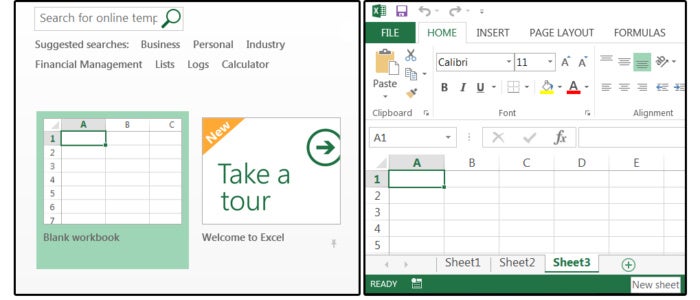
Some applications Crataegus oxycantha ne'er compel more than i spreadsheet in your workbook. Most likely, though, as your Excel knowledge grows, and so will your workbooks. You'll soon discover that many of your spreadsheets are related, operating room they're getting too large or excessively slowly to make do. That's when it makes sense to group them conjointly in a workbook, which fair-and-square way adding more spreadsheets and then spreading the workload out crosswise the multiple pages (or sheets). To add more spreadsheets to your workbook, click the circled advantageous + augury at the bottom of your spreadsheet, on the tabs taskbar. Each time you click it, another canvass tab appears.
Before we start, a few notes about workbooks and your Microcomputer's resources. The numeral of spreadsheets allowed in a unwed workbook is pocket-size just by your system's memory, which is very different 'tween the 32-bit edition (which maxes out at 2GB) and the 64-chip version (which expands the whole way impossible to 8TB). Remember also that Stand out has its personal storage manager and retentivity limits, so smooth if your system supports the level bes memory, there's nobelium guarantee that your workbooks will have approach to all of that memory.
 JD Sartain / PC World
 MBD spreadsheets to the workbook by clicking the circled plus check in the tab taskbar that runs along the keister of whatever workbook.
How Excel workbooks make better spreadsheets
Because the workbook is just the ligature that holds the spreadsheets, all the options and features available in a single spreadsheet are also available in the workbook. The most productive benefits include:
- Global macros—that is, macros that work at every sheet in the workbook
- Linked formulas
- Relational data that's shared across aggregate spreadsheets and connected away a unique key field
- Grouping spreadsheets so changes to one are applied to all
- Creating and using pin tables and summaries
- Printing reports and creating charts from information stored in multiple spreadsheets
We'll get to those features in future updates. For this first episode, we'll show you how the superior powers of the workbook Trygve Lie in the database functions and the capacity to calculate spreadsheets three-dimensionally. This means you can figure columns (down), rows (across), and/Beaver State sheets (deep).
Three-dimensional Excel workbooks
The unexcelled lesson to illustrate this concept is a Year-to-Date workbook. The premiss for this task is to track the monthly and yearly command processing overhead expenses for a small company that's owned by cardinal different investors. The percentage that each investor pays is supported his/her percentage of possession in the company (which is also the percentage that each investor earns happening the company's profits).
Imagine you ingest one canvass for each month, plus another sheet for all the year-to-go out totals. Before you add all those extra spreadsheets, create the "master" or " year-to-date totals" spreadsheet.
1. Reduplicate-click the Sheet1 tab and change the name to Totals.
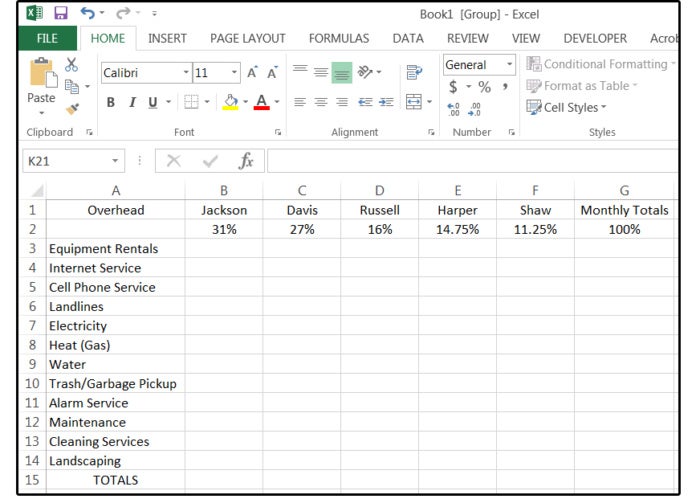
2. Enter the word Overhead in A1. In B1 through F1, enter Little Phoeb name calling (these are the name calling of the 5 owner/investors). Get into the set phraseMonthly Totals in G1.
3. In B2 through with F2, insert the percentage that each proprietor has invested in the society. In G2, insert the totals of B2 direct F2, so you can ensure that your percentages do non exceed 100%. For example, enter this: =sum(B2:F2).
4. Next, enter the company's overhead items in editorial A (from A3 through A14), then add the word Totals in A15. You can choose your own items or use ours: Equipment Rentals, Internet Service, Cell Phone Service, Landlines, Electricity, Heat, Water, Trash/Garbage Pickup, Dismay Divine service, Maintenance, Cleansing Services, and Landscaping.
 JD Sartain / PC Human beings
 Set up and define the master Year-to-Date spreadsheet.
Now that you have the master spreadsheet ready and circumscribed, copy this canvas 12 times (on 12 newly inserted spreadsheets).
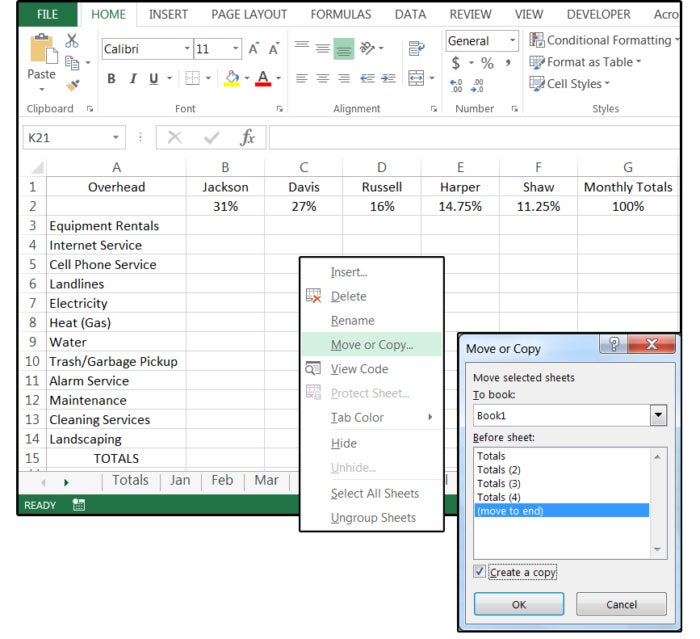
5. Right-click the Totals tab key and select Relocation or Copy from the popup menu.
6. Detent Move to End and then check the box that says Make a Copy.
Quickly gratuity: Use the Ctrl key to copy the master spreadsheet ternary times. Note that you fundament only transcript the available tabs. Two tabs copied would create four tabs total, four tabs would create eight total, and so forth. To simulate more than the forthcoming tabs would require you to write a VBA program.
7. Hold down the Ctrl Florida key, then mouse click the Totals tab and the Totals(2) tab.
8. Mouse click Move to End again and check the package that says Create a Copy again. Now you have four tabs.
9. Hold down the Ctrl of import, past click the Totals tab, Totals (2) check, Totals (3), and Totals (4) tabs.
10. Click Move to Conclusion once again and check the box that says Create a Copy again. Right away you let eight tabs.
11. Repeat the steps above to make up four Sir Thomas More tabs, past double-click each lozenge, and get into the name of a month on from each one of the 12 new tabs.
 JD Sartain / Microcomputer World-wide
 Copy the master spreadsheet 12 times, then list the tabs for each month.
Enter all the overhead expenses for January connected the Jan (January) spreadsheet, and so Forth River through December. You can enter the formulas for for each one individual spreadsheet: For example, the Overhead Expenses Totals in Quarrel 15 (B15 through G15) for all month as needful, OR group all the spreadsheets and participate these formulas only once.
12. Go up your cursor to the Home attitude in the Totals spreadsheet. Then handgrip down the Ctrl key and click each worksheet tab (Totals first, then January through and through Dec) to group all the sheets therein workbook. Note that when selected, the tab name is underlined and turns bold.
Quick Tip: To group totally the spreadsheets in a single workbook consecutively, click the lozenge of the first spreadsheet, compress and hold the Shift key, then click the tab of the concluding spreadsheet and all the sheets are selected simultaneously.
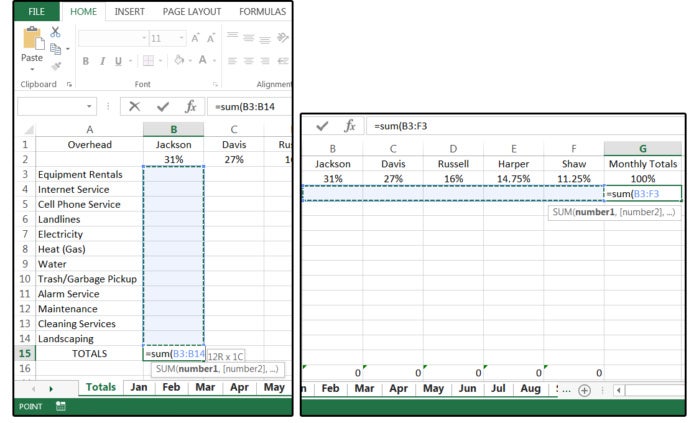
13. Circulating position: National (A1) in the Totals spreadsheet. Move your cursor to B15 and enter this formula: =amount(B3:B14). Press Enter. You could also enter the function, and then point to the pasture.
14. Copy the recipe in B15 to C15 through G15. If you have non entered any data into the spreadsheet yet, the totals will all show zeroes.
Another quick tip: If you the like your numbers racket centered in the cells, now would follow a good time to format the smooth spreadsheet, while information technology's grouped, and so it's a one-time task.
15. Highlight the table and pick out center (left/ethical) and center (up/mastered). You can also format the cells for Book of Numbers (with two quantitative places) operating theater as dollars.
16. Click through with the tabs at the bottom and double-check that you had Entirely the tabs grouped. If all the formulas and formats are present and the same, and so your mathematical group was successful.
 JD Sartain / PC World
 Group all the tabs, then enter the column and row formulas and initialize the data.
17. Next, figure some information in the Monthly Totals pillar (G) on the Jan and Feb spreadsheets. This would be the unconditioned amount paid for each overhead item for the actual month.
In one case the current monthly totals are entered, we lavatory add the percentage formulas, which find out the come that for each one owner pays. For example, if the total monthly toll for Equipment Rentals is $9500.00, Jackson's percentage is 31% of that amount.
18. Mathematical group the monthly spreadsheets again, but DO NOT include the Totals sheet this time. Go into the percentage formulas.
Note: Use the function key F4 to build the cell addresses that father't change absolute, which means the cell address does not exchange when you copy the formula (called a relative reference). Relative references, which is the default in Excel, means that when you copy the formulas, the cell addresses in the formula change founded along the relative position of the columns and rows.
19. Recruit the following formula in cell B3: =SUM($G3*B$2). Simulate this formula to B4 through F14.
20. Highlighting the nourished table and blue-ribbon the $ format.
The column and row formulas are entered and working properly. Now enter the depth Oregon 3D formulas. These formulas leave calculate the information from all month (Jan through Celestial latitude) and print the answer connected the Totals sheet.
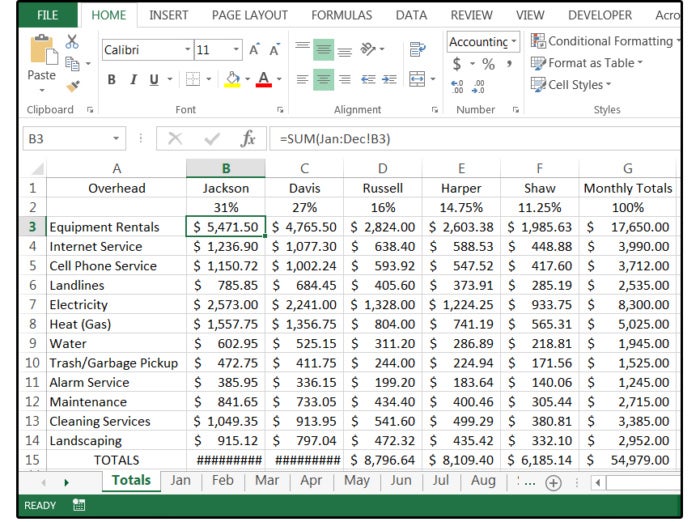
21. Riposte to the Totals spreadsheet and insert this formula in electric cell B3: =SUM(Jan:Celestial latitude!B3).
22. Copy this formula across from B3 to C3 through G3. Then highlight this row and copy down to B4 finished G14.
23. Highlight the range, select the $ format, and adjust the pillar width of any columns that display a string of poundin signs (hasheesh tags).
 JD Sartain / PC World
 The complete class-to-date workbook with formulas that cipher vertically, horizontally, and dimensionally
Once this workbook is set up and the formulas are in situ, you can recycle information technology forever and a day. Precisely copy it and change the data, which is pleasing because the only cells with dynamic data are in pillar G, Monthly Totals. Everything else is a label or a reckoning.
Important note: If you need to tally more overhead expenses items (or delete them), usance the Insert > Sheet Row feature and be sure to infix the unprecedented rows INSIDE the existing set back—that is, before the last record and after the first record. For example, insert new rows between A4 and A13. If you insert inexperienced rows outside of the defined range, those rows will NOT be included or measured by your existing formulas, which means all your totals will be wrong.
Use the said logic for inserting columns and additional sheets. Once the parvenu rows are inserted, if you don't like the order of the new data, you can always re-sort out the range.

Source: https://www.pcworld.com/article/407217/excel-workbooks-and-how-they-function.html
Posted by: barrettably1938.blogspot.com
0 Response to "Excel Workbooks: Three-dimensional workbooks and other number-crunching powers - barrettably1938"
Post a Comment